| NGC 5474 & Company (near M101) | ||
|---|---|---|
|
||
There are several smaller galaxies that are often overlooked near the famous M101. There is some irony to be found here because these smaller, fainter galaxies are probably easier to find than their famour neighbor! M101 is a classic example of how difficult it can be observe galaxies of low surface brightness. The integrated magnitude of M101 is a bright 8.2, and if it were all concentrated into a star, M101 would be a piece of cake. But instead, all that light is spread out over a circular area roughly 30' in diameter. I'm convinced that M101 is the most difficult of the Messier objects. My search for M101 began over two decades ago as I scoured my "Atlas of the Heavens" for objects to view in my newly acquired 6" telescope. A bright Messier galaxy that made an equilateral triangle with the two stars at the end of the handle of the Big Dipper seemed like an easy target. But try as I might, I couldn't find it. Over the years I searched again and again with all sorts of instruments, from binoculars to a 21-inch telescope. Always to no avail. After 20 years of searching I found myself at Mount Laguna, about 50 miles east of San Diego. It was March of 1996, and we were blessed with one of those once-in-a-lifetime nights with crystal clear air and a velvety-black sky. Stretching some 50 degrees overhead was the most amazing comet I had ever seen. I followed Hyakutake's magnificent tail in my 8x56 binoculars, looking for knots or other structures. Right there, embedded in the tail, was this small round smudge. I wondered aloud what it was... after all I didn't know of any bright galaxies in that area. Was it part of the tail? The comet moved during the next few hours, but my smudge did not. With a sudden flash of insight I realized what it was--I had finally found M101! The funny thing is that ever since, I've had little trouble finding it. Knowing what to look for is a big part of the battle. How large is it? How diffuse? Exactly where should I look for it? That's where really good charts can come in. But I digress. NGC 5474 is a 11.3 magnitude, face-on spiral galaxy. It appears as a round, 5' smudge of light, less than 30' to the northeast of it's famous, sometimes hard to find, neighbor. Smaller scopes will show the smaller, bright core. Larger instruments will show the surrounding haze. This galaxy is actually an interacting pair, which explains its strange shape. 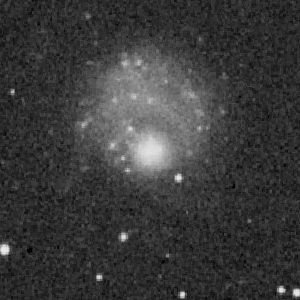
This image is from the Digital Sky Survey and shows 6' x 6' region around NGC 5474. 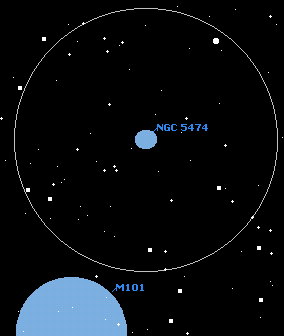
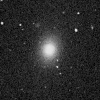
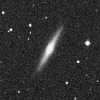
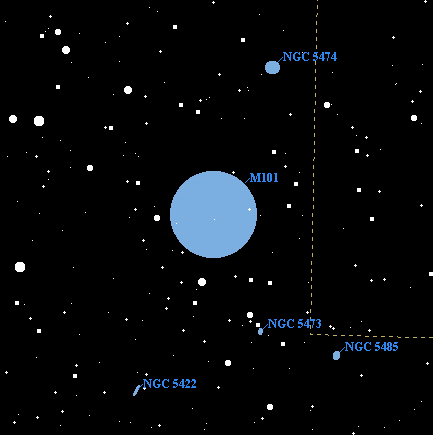
The view in a 6" at 50x. N is down, E is right. There are several other galaxies in the area of M101, the brightest of which are NGC 5473, NGC 5485, and NGC 5422. All three of these galaxies lie at a distance of about 80 million light years. NGC 5473 is a 12.4 magnitude Lenticular galaxy. Look for a 2' x 2' smudge of light. NGC 5485 is another Lenticular galaxy that bears a remarkable resemblance to NGC 5473. It is only slightly larger and fainter. NGC 5422 is another Lenticular, seen edge-on. It shines at magnitude 12.9 and appears as a thin, 3.5' x 0.6' streak of light.
|
||
|